




Choose an SSL Security Certificate
SSL Security Certificate
What is an SSL Security Certificate? What is the purpose of that famous “S” in the HTTPS:// URL address that precedes your Domain Name? What type of Security Certificate should you choose for your website? What is an SSL Certificate?
For the uninitiated, this article begins poorly with all these technical terms. Let’s start by demystifying them.
The internet has evolved significantly since the late 1980s. Fundamentally, the internet allows for establishing a communication link between a computer and a server, regardless of its global location.
What is a URL?
This English term means “uniform resource locator“. The Larousse dictionary defines it as an address that specifies the location of an Internet resource by indicating the communication protocol to adopt to reach its destination via a path leading to a web page or a file. It is nothing less than the address of your store located on a very busy street.
What does HTTP mean?
This term means “Hyper Text Transmission Protocol“. It is a communication protocol between browsers (Safari, Chrome, Firefox, …) and web servers that allows you to access a website and interact with its content.
With the growth of online transactions (ecommerce), this transmission protocol has been enhanced to secure the exchange of personal and confidential information transacted between an organization’s website and its customers’ computers, tablets, or smartphones.
HTTPS: The Secure Web Experience
You will have understood that the S in HTTPS stands for “Hyper Text Transfer Protocol Secure“. The SSL Security Certificate can be compared to an ultra-sophisticated password. This password, also known as an encryption key, contains hundreds of characters and symbols. Each key is randomly generated by advanced algorithms to make it undecipherable.
When you enter personal information into a form on a website protected by an SSL Security Certificate, it will be encrypted before being transmitted to a secure container. The complexity of the encryption keys protects you and deters interception attempts. In short, this is the role of the SSL Security Certificate.
The SSL Security Certificate
Furthermore, SSL Security Certificates are constantly improving. Consequently, encryption algorithms become more complex year after year. Annually, your SSL Certificate must be renewed to fully benefit from the latest SSL security algorithms.
Most SSL Certificates are only valid for one year. However, some offer a 2-year validity period. These are more specialized products.
Which one to choose for your website?
The choice of an SSL Security Certificate varies depending on the exchanges and the confidential nature of the data transacted between your client and your website or web application.
For example, if your website only has a simple information request form where only basic information is requested, then, in this case, the basic security certificate included in your package will suffice.
Otherwise, you must opt for more advanced SSL Security Certificates. Broadly, here are the different types of Certificates:
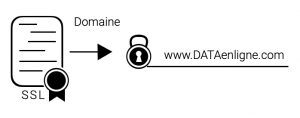
- Domain – for 1 single Domain Name (with or without www.) – e.g., www.DATAenligne.com or DATAenligne.com
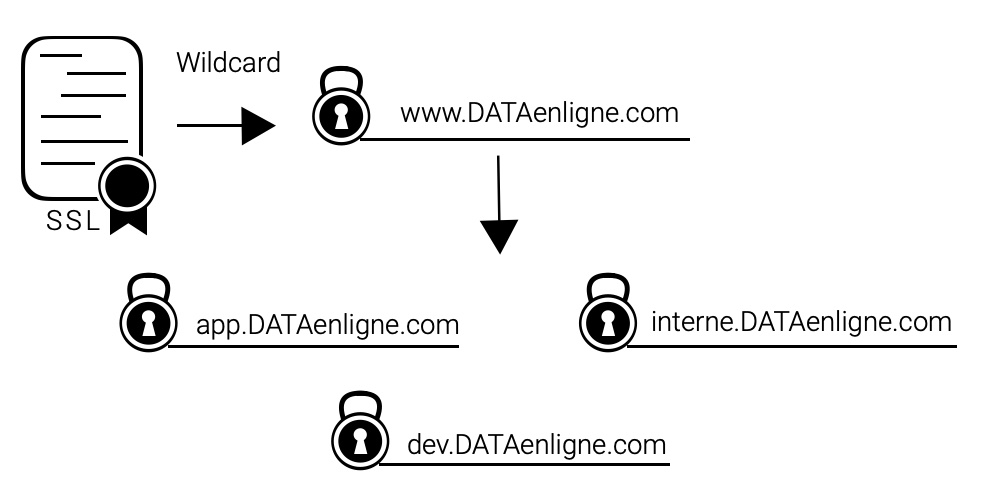
- Wildcard – for 1 single Domain Name (with or without www.) and all its subdomains – e.g., www.DATAenligne.com or DATAenligne.com and app.DATAenligne.com; dev.DATAenligne.com; interne.DATAenligne.com
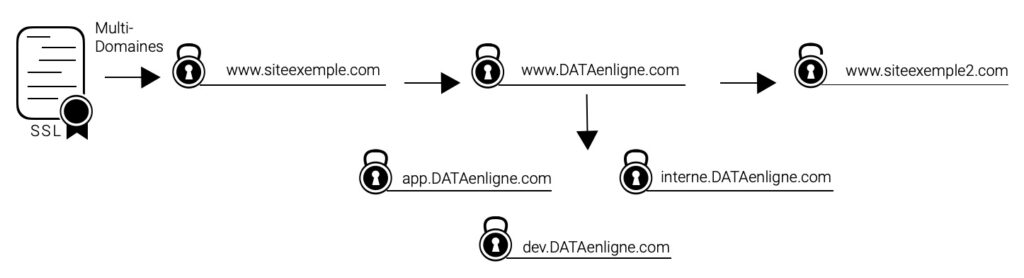
- Multi-Domain – 1 single SSL Certificate protecting multiple domain names (with or without www.) and all subdomains.
Google and HTTP vs HTTPS
Another good reason to add an SSL Security Certificate to your website comes from the giant Google. Since 2017-2018, the Google search engine verifies and prioritizes websites with an SSL Certificate in its search results. Google systematically penalizes unprotected (HTTP) sites in search results.
Now you know why your website’s URL must start with HTTPS://. It’s a matter of credibility and trust.
Do not hesitate to contact me if you have any questions or doubts regarding the choice of your SSL Security Certificate.