





Cloud Services
Cloud Computing: Machines and People.
We hear about it and form our own ideas, but do you know what the famous ‘Cloud’ is actually based on? In reality, the foundations of the internet are built upon cloud services and cloud management.
Turbulence in the ‘Cloud’ is a completely different topic that I will address another time. Now, here’s a brief overview of the topics covered in this article:
- What is Cloud Computing?
- Cutting-edge technology under the cloud
- Environmental and Economic Challenges
- Information Highway, Artificial Intelligence (AI), and Pandemic
- Cloud Services
- Cloud Management
What is Cloud Computing?
The Internet is a large, complex, and turbulent cloud that presents itself as a virtual whole accessible from anywhere in the world. During the 1970s, the word Internet began to circulate among the most knowledgeable in computing. The objective then was to interconnect computer systems into networks.
In November 2009, the term ‘infonuagique’ was proposed by the Office québécois de la langue française to define and clarify the English term ‘Cloud Computing’. ‘Cloud computing’ or ‘computing cloud’ are also synonyms used to define ‘infonuagique’.
The concept of cloud computing is still nebulous for many people. Without sophisticated technological equipment in IT and telecommunications, the cloud would not exist.
Cutting-edge technology under the cloud
Creating worldwide interconnectivity requires significant investments. The cloud would not exist without the millions of kilometers of submarine communication cables that connect continents. Furthermore, orbiting satellites enhance this wireless communication coverage.
These communication links instantly transport voice and data across our planet. This technological feat would not be possible without these communication links and computing.
Imagine that for every interaction made from a browser or web application, a computer server processes your request and returns a result within seconds. According to Google statistics, over 40,000 searches are performed every second.
However, these advanced technologies remain sensitive to solar storm phenomena. Scientists assert that a solar storm could have disastrous impacts on our technologies. The possibility of an Internet outage is taken seriously. Research projects are underway to strengthen these infrastructures.
Environmental and Economic Challenges
The growing demand for the internet necessitates significant investments. Regularly, new investments in the construction of new data centers are announced. An industry is booming.
In a data center, ambient temperature and humidity must be controlled to prevent overheating or premature failure of IT and telecommunications equipment. You will have understood that Data Centers are major energy consumers.
In Quebec, our low electricity costs attract international investments that create jobs here. This clean energy is a significant economic advantage!
Data centers are multiplying worldwide, as is the power of servers and IT equipment. The hardware and software requirements of web projects starting up or growing are pushing the boundaries of technological capabilities and innovations.
Information Highway, Artificial Intelligence (AI), and Pandemic
In the early 1990s, the Quebec government’s program and its information highway project enabled several companies to launch innovative information technology projects. The objective of this program is to create a model for Quebec’s economic development of tomorrow.
Over the past 30 years, we have seen all sorts of web projects emerge and disappear. We have witnessed major battles between Altavista, Yahoo, and Google. We have seen the disappearance of Napster, ICQ, and many others. Today, augmented reality and Artificial Intelligence (AI) are at the heart of our daily lives. These companies would not exist without the power of cloud computing.
Henceforth, cloud servers are essential for entrepreneurs, creators, and innovators of web projects. Public organizations are no exception. The trend in the web is more than ever oriented towards mobility and accessibility.
In March 2020, the Covid-19 pandemic accelerated global demand for cloud services. The world adapted to the constraints related to isolation. Many companies experienced rapid growth with remote work. Some companies broke online sales records. Cloud computing largely contributed to this paradigm shift.
No one can claim to know the future digital projects that will revolutionize our lives in 10 or 20 years. Technologies will continue to evolve to offer ever more performance and possibilities. The same applies to the different types of cloud services.
Cloud Services
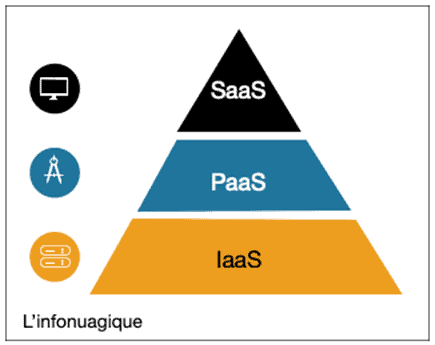
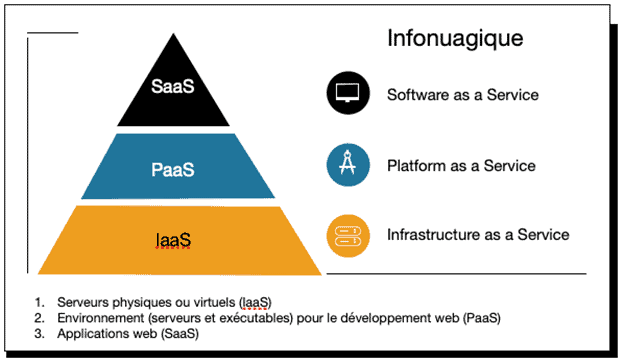
Are you familiar with the acronyms IaaS, PaaS, or SaaS?
These are types of cloud services offered in private hosting, public hosting, or a combination of public and private hosting, known as hybrid.
Each type comes with a basic support service related to its offering.
In brief, here is a descriptive summary of these types of cloud solutions:
IaaS

The first level of cloud services concerns infrastructure or Infrastructure as a Service (IaaS). This service is offered by large companies owning Data Centers. It allows a third party to rent a cabinet in which one can install their own IT equipment or to rent physical or virtual servers with the required hardware and software resources (memory, storage, communication, OS, Apache, nGinx, PHP, IIS, MySQL, MSSQL) to launch their web project online.
Responsibilities vary from one provider to another, but they are generally limited to maintaining the service (cabinet, electricity, communication, physical/virtual server, software) according to the agreement concluded for the rented services. If you are renting physical or virtual servers, it is your responsibility to ensure that each environment (server) is up to date to avoid potential security vulnerabilities.
Among the major providers are Amazon, Microsoft, and OVH. The level of support is limited to service delivery.
Infrastructure as a Service allows for the creation of customized solutions, from a simple dedicated or virtual server to a server cluster (web cluster) for more advanced solutions. The possibilities range from simple website hosting services to disaster recovery solutions (DRP – Disaster Recovery Plan). Each web project has its own specific technological needs.
PaaS

PaaS is a cloud service (Platform as a Service) designed for businesses and web application developers. This platform allows for the rapid deployment of virtual containers equipped with resources adapted to a web development project (CPU, RAM, Storage, OS, DB, …) in addition to providing great flexibility in managing and configuring a virtualized environment for application development.
Responsibilities vary from one provider to another, but generally, they are limited to maintaining service delivery and its communication network. It is your responsibility to ensure that each environment is up to date to avoid, among other things, potential security vulnerabilities.
Among the major providers, the names Amazon, Microsoft, and Google are the most common. Their level of support is limited to service delivery.
SaaS
Software as a Service (SaaS) is the last type of cloud services. This business application-oriented model offers businesses or individuals web access to a complete software solution. From a web browser, the application and the infrastructure on which the service is offered are entirely managed by the provider.
There is a wide range of SaaS software. For example, it includes ERPs (integrated management systems), CRMs (customer relationship management systems), sharing and collaboration applications like Nextcloud, and WebMail (email sending and receiving systems). These are all software solutions offered in cloud computing.
Responsibilities vary from one provider to another, but they are generally limited to maintaining service delivery. However, you do not have to worry about the equipment, as this responsibility falls to the provider.
For any of these three types of cloud services, each web project requires its own specific technological solution. The web infrastructure underlying the service can be simple or complex in its hardware and software configuration.
Overall, IaaS, PaaS, and SaaS service types cater to clienteles with very different needs and realities.
In each case, the expertise of infrastructure management specialists is essential to install, configure, diagnose, correct, optimize, monitor, and maintain your service up to date to avoid unpleasant surprises.
Do you have a cloud management expert who oversees your cloud service and ensures the success of your web projects?
The human factor: the indispensable element for all web projects.
Cloud Management
The human element in your web project is concerned with cloud management. It is a determining factor in the success or failure of a web project. Our experts’ skills offer startup or growing businesses access to specialized resources who master the techniques and possess knowledge of the cloud services we have described above.
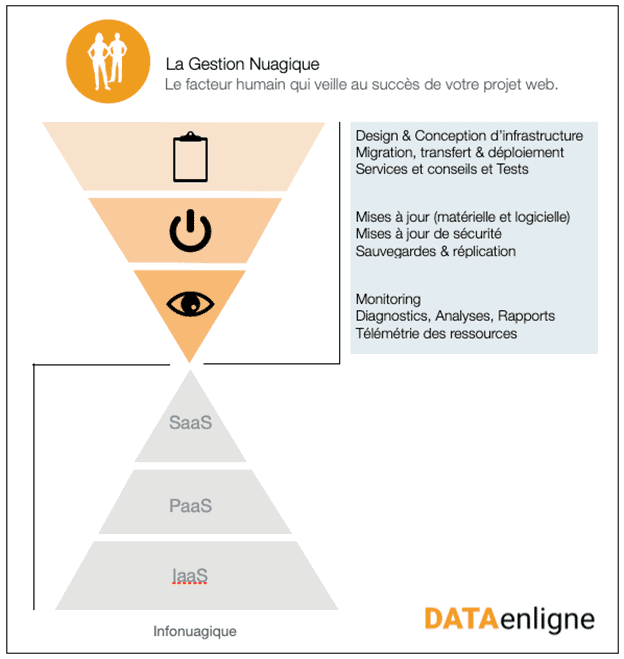
According to your project’s specifications, our cloud management experts ensure the technological choices for your project align with the challenges, stakes, and objectives outlined by your organization.
Design, Conception & Deployment
Our expertise in web architecture design allows us to create a cloud environment specific to your web project. Performance, accessibility, elasticity, and security are key elements that influence technological choices for all web projects.
Our cloud management experts install and configure each server (Web, DB, Proxy, Firewall, …) according to your web project’s requirements.
Before the deployment and commissioning of your project, we conduct quality tests. Our monitoring tools are then deployed to vigilantly oversee the health of your web environment’s hardware and/or software components. The final adjustments to the environment’s configuration parameters are validated with each client before their project’s official launch.
Updates & Backups
Regularly, operating system and software producers recommend performing updates (critical or security) or upgrading to a new version of their product. Our cloud management experts manage your cloud service so you don’t have to worry about it. Thus, your environment always remains up to date.
Furthermore, we take responsibility for managing your service’s backups. This is a priority we manage daily, weekly, and monthly. We store backup copies locally to quickly restore certain files or an entire environment. In anticipation of the worst-case scenario, we keep an off-site copy of these backups. This measure, in the event of a major failure, allows your service to be restored to another infrastructure or data center.
Monitoring & Optimization
In real-time, our “Monitoring” system informs us about the health status of your service. If a problem occurs, we are quickly informed to validate the situation and correct it if necessary.
These remote monitoring and telemetry tools provide us with information and indicators on cloud services. This information and these indicators are excellent guides that help us determine the sources of potential weaknesses. Our tools allow us to diagnose the situation and correct it, improving the service as a whole.
The objective of Monitoring aims, among other things, to:
- ensure the accessibility of your service on the web at all times;
- monitor the health of your service’s hardware and software resources;
- optimize each service to offer the best interactive experiences on the web.
Sometimes our tools do not allow us to understand all the subtleties of a problematic situation. In such cases, we recommend installing specialized analysis tools. The advanced functions of this analysis tool provide impressive data on the application behavior of a web project across the resources of one or more servers.
We are confident in providing our clients with relevant information for the improvement of their web project.
Cloud management is the human factor behind all web projects.