



PUBLIC PRIVATE OR HYBRID CLOUD
How to choose? Here’s a guide to better understand the differences
Choosing a Cloud infrastructure to host web applications, databases, or websites is intrinsically linked to the technological and strategic success of your organization. But how do you know which approach best suits your needs and reality? This guide on Public, Private, or Hybrid Cloud could help you better understand the differences to guide you in making an informed decision.
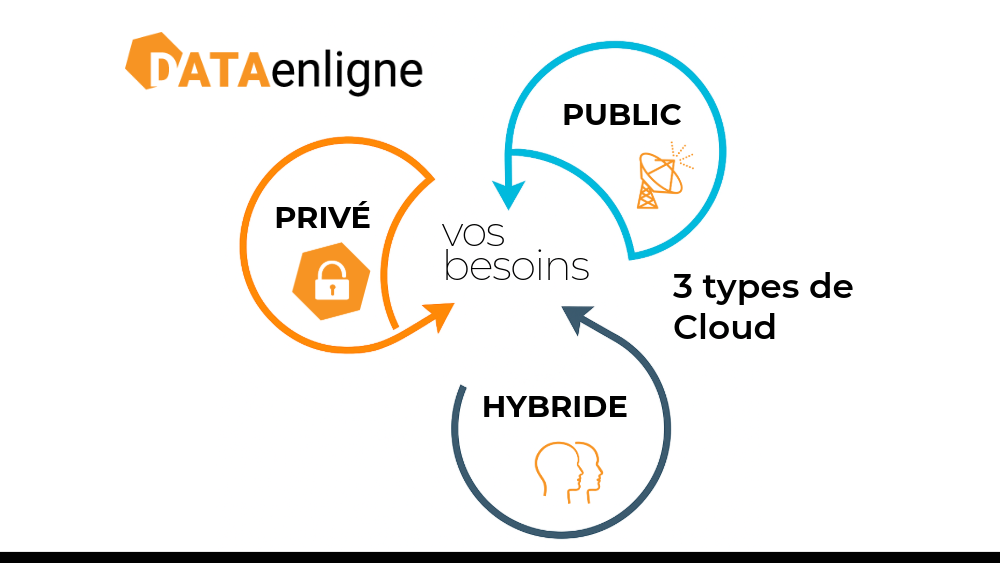
Before going into detail, let’s clarify some fundamental differences between the three (3) types of Cloud.
| Type | Resources | Security & Control | Typical Use Case | Billing Type |
|---|---|---|---|---|
| Public | Shared with a provider | Low to moderate | Mobile apps, variable traffic sites | Pay-as-you-go (per minute/GB) |
| Private | Dedicated, isolated | High | Sensitive data, regulatory compliance | Fixed cost (monthly or annually) |
| Hybrid | Public/private mix | Customized according to usage | Varied needs, performance and security | Mix: fixed + variable |
- Public Cloud: you rent resources (storage, CPU, memory) from a third-party provider (e.g., AWS, Azure, Google Cloud). These resources are shared with other clients.
- Private Cloud: resources are entirely dedicated to your company. Hosted on your own servers or in an isolated environment managed by a provider (e.g., DATAenligne), you retain full control over the performance (machine power), security (firewall rules), and resilience (RPO & RTO) of your infrastructure.
- Hybrid Cloud: combines both models, allowing a company to run certain applications on a Public Cloud while keeping sensitive or critical data in a Private Cloud.
1. Public Cloud: flexibility and savings
- Advantages:
- Low initial costs
- Rapid resource elasticity
- Ease of use
Example: A mobile application experiences high traffic peaks during holidays and seasonal events. The Public Cloud allows for instantaneous capacity adaptation without significantly inflating the operating budget of a startup organization.
– Digital entertainment startup
2. Private Cloud: maximum control and security
- Advantages:
- Enhanced security
- Total control over data
- Customized performance
- Strict compliance adherence
Example: Processing sensitive financial data daily requires choosing a dedicated and highly secure infrastructure (Private Cloud) that perfectly adheres to regulatory obligations.
– Financial services firm
3. Hybrid Cloud: tailored balance
- Advantages:
- Optimal balance between security, cost, and flexibility
- Enables hybrid scenarios (e.g., private sensitive data, public applications)
Example: The online e-commerce site must be fast, but customer and transaction data must be subject to maximum security. Hybrid allows for intelligent resource allocation based on their sensitivity level.
– Multi-region online retailer
How to make the best decision?
- Clearly identify your priorities: security, cost, performance, compliance, and risk tolerance.
- Evaluate your internal expertise: do you have the necessary expertise to manage a complex solution?
- Consult experts: specialized partners, like DATAenligne, help you make the right decision based on your current and future needs.
DATAenligne specializes in the design, installation, migration, and maintenance of Proxmox Private Cloud. Depending on the needs of your web project, we can also advise you on combined approaches that require a hybrid solution to allow you to benefit from the best of both worlds.
Our goal is to support you in implementing a solution perfectly adapted to your ambitions.